
AS TRIAL OF BUFFALO MASS KILLER NEARS, A LIFE-OR-DEATH ISSUE
Can the words in jury instructions be the difference between life and death?
That’s the question that confronts U.S. District Judge Lawrence Vilardo, who will preside over the capital trial of racist killer Payton Gendron.
Beginning June 15, prospective jurors are scheduled to come to a federal courtroom in Buffalo to answer an expansive written questionnaire.
Before dealing with the questionnaire, the prospective jurors will hear instructions from Vilardo that will describe the allegations against Gendron—he has pleaded guilty to the murders in state court—and inform them that, if selected, they could be part of a two-phase proceeding.
If Gendron is found guilty after trial, and it’s extremely hard to envision a situation in which he would be acquitted, the jurors then will determine whether he should be executed for his murders of 10 Black people at a Tops supermarket in Eastside Buffalo in May 2022.
In the instructions, the prospective jurors will be told of Gendron’s 2022 guilty plea in state court “for these same acts” and the subsequent sentence of life in prison without possibility of parole.
“While the State of New York does not have a death penalty, this is a federal case, involving violations of the laws of the United States, rather than a state case involving the laws of New York,” the proposed instructions say.
But when it comes to a possible death sentence, prosecutors and defense lawyers differ on just how prospective jurors would be told of the choice. A mere change in the order of instructions could unfairly lead the jurors to a decision for death, the defense has argued.
Which should be first: life or death?
In the instructions, Vilardo was offered the option of saying “If, and only if, the jury finds Payton Gendron guilty of any of the capital murder counts, there will be a penalty phase of the trial in which the same jurors will have the responsibility of deciding whether Payton Gendron is sentenced to life in prison without the possibility of release or, instead, sentenced to death.”
These were the words the defense preferred.
Prosecutors preferred this: “If, and only if, the jury finds Payton Gendron guilty of any of the capital murder counts, there will be a penalty phase of the trial in which the same jurors will have the responsibility of deciding whether Payton Gendron is sentenced to death or to life in prison without the possibility of release.”
The change may be minimal, whether the choice of life without parole or death should be mentioned first, but defense lawyers see it as significant.
Providing execution of Gendron as the first option could create a risk that “jurors incorrectly assume that the law or the Court presumes the imposition of a death sentence is the preferred or appropriate sentence in this case,” defense lawyers wrote in a recent court filing.
“The government is seeking the most severe and ultimate penalty available under the law, and it is respectfully suggested that it makes the most sense and is most appropriate to present the sentencing options from lesser to more serious,” defense attorneys added.
In the most recent federal capital trial, with the defendant Robert Bowers, the judge listed life without parole first, according to the defense papers. The jury did choose capital punishment for Bowers, a white nationalist who in 2018 murdered 11 congregants at the Tree of Life synagogue in Pittsburgh.
Prosecutors argue that the government bears the burden of making the case for execution.
“The government submits that throughout these instructions, when listing the two possible potential penalties, the death penalty should be listed first,” court papers show. “The government is seeking this sentence and has the burden of persuasion to obtain this sentence. Thus, it logically should be listed first.
“Only if the government fails to satisfy its burden should the jury consider a life sentence.”
Attorneys will review the questionnaires to determine a pool of possible jurors for the next phase. The trial is tentatively set to start in October.
Trial approaches for victims’ families
With Gendron’s trial now approaching, this week I reached out to Garnell Whitfield Jr., whose mother, Ruth, was one of the 10 murdered at Tops. At 86 years old, she was the oldest victim.
Whitfield has become an activist in the aftermath of the murders. (An earlier story of mine, from USA Today: “His mother was killed in Buffalo’s racist shooting. How he has turned grief into activism)
“It’s not something honestly that I look forward to or am anticipating,” he said of the trial in a telephone conversation from his Buffalo home.
An opponent of the death penalty, as was his mother, Whitfield said he’d prefer to see Gendron serve life without parole and suffer a prison existence for decades to come.
“He’ll never see the light of day,” Whitfield said. “I’m not worried about him.”
Among the victims’ families there are differing opinions on whether Gendron should be executed. This shouldn’t be seen as a schism, said Whitfield, who previously served as Buffalo’s fire commissioner.
Instead, the differences derive from different life experiences and even different faiths, he said.
Whitfield said he does not plan to attend the full trial but will go some days to show support for the families.
Whitfield and others have sued social media companies and platforms, alleging that Gendron’s racism was emboldened and grew via those networks. A regional appellate court has dismissed those lawsuits, but appeals continue. (See my earlier piece: “Appellate court dismisses lawsuits against social media companies in Buffalo massacre”)
Gendron, who was 18 at the time of the killings, espoused a “white replacement” theory that has circulated in white supremacist circles—a claim that there is an organized effort to replace the power of white people in the United States.
“Nobody’s born to believe and think the way he does,” Whitfield said. “That’s learned behavior. He was influenced by society.”
Gary Craig is a Rochester Beacon contributing writer. A retired Democrat and Chronicle reporter, he now writes on Substack.

United States District Court – Western District of New York Photo Courtesy Glenn Murray, Esq.

Attorneys for Payton Gendronhad sought to move the trial out of the city, arguing in a court filing it would be difficult to seat a diverse and impartial jury. Defense attorneys requested the trial be moved to Rochester.

U.S. District Judge Lawrence Vilardo ruled that while jury selection may take longer, the case should remain in Buffalo, balancing the interests of victims with the defendant’s right to a fair trial

In November, 2022 Gendron pleaded guilty to all state charges in the shooting, including murderdomestic terrorism, and hate crimes in an attempt to avoid the death penalty. On February 15, 2023, Gendron was sentenced to 11 concurrent life sentences (plus 90 years) without the possibility of parole. Gendron is serving a sentence of life in prison without the possibility of parole after pleading guilty to multiple state charges, including murder. He killed 10 Black people and injured three others when he opened fire at the Tops on Jefferson Avenue on May 14, 2022

Jury selection in Buffalo s expected to begin in August, with the trial scheduled to start in September.

CAPITAL PUNISHMENT

The Capital Punishment Project works toward the repeal of the death penalty in the United States through strategic litigation, advocacy, public education, and training programs for capital defense teams.

NEW YORK – The American Civil Liberties Union released Fatal Flaws: Revealing the Racial and Religious Gerrymandering of the Capital Jury today, a report that exposes how the process of “death qualification” warps juries in capital trials. Death qualification requires that jurors be willing to impose a death sentence to serve on a capital jury. Drawing on consistent studies from multiple states across the country, the report reveals how this process disproportionately excludes Black prospective jurors, women, and people of faith from serving in some of the most important cases heard in American courthouses.

“The Constitution guarantees that every person accused of a crime has the right to be tried by a jury of their peers, but that promise is by definition denied for people facing the death penalty,” said Brian Stull, deputy director of the ACLU’s Capital Punishment Project. “Death qualification systematically excludes prospective jurors based on their race, sex, and religion, violating their own rights to civic participation. The resulting juries do not reflect our communities, convict more frequently, and are composed to ignore evidence favoring a life sentence in violation of our Constitution. Justice depends on equal access to the jury box. We must demand and end to this cycle of discrimination and exclusion once and for all.”

Key findings from the report include:

  • Death qualification disproportionately excludes Black prospective jurors. Black Americans, as a group, are more likely to oppose the death penalty due to the racist roots of the capital punishment system. As a result, this process disproportionately removes Black Americans from capital juries, and Black women at the highest rates of all.
  • Death qualification unfairly excludes people of faith whose religious beliefs oppose capital punishment. Some religious groups, such as Quakers, Buddhists, and Catholics formally reject the death penalty and many others have expressed serious concerns with capital punishment. Studies across the country confirm that people of faith are disproportionately excluded from capital jury service, even though they can impose lawful verdicts on both conviction and sentence.
  • Death qualification systematically excludes growing numbers of Americans from jury service. Changing views on the death penalty make the exclusionary effects of death qualification even more pronounced. At least 44 percent of Americans oppose the death penalty, meaning nearly half of the country is potentially disqualified from capital jury service.
  • Death-qualified juries are more likely to convict and to ignore evidence in favor of life in violation of the Constitution. Death-qualified juries act differently than those that are not. They are more likely to convict, to ignore evidence favoring life over death, to be influenced by racial bias, and to deliberate less thoroughly.

The report also urges state legislators to pass laws banning the exclusion of jurors opposed to the death penalty who can follow the law, calls on prosecutors to decline to death qualify jurors, and recommends that defense counsel mount challenges to death qualification by introducing evidence of its discriminatory effects.

The full report can be found here: https://www.aclu.org/publications/fatal-flaws-revealing-the-racial-and-religious-gerrymandering-of-the-capital-jury

Learn more about the ACLU’s work challenging death qualification here: https://www.aclu.org/news/capital-punishment/the-sinister-and-racist-practice-infecting-death-penalty-juries

Alabama Governor Commutes Death Sentence of Sonny Burton

Alabama Gov. Kay Ivey commuted the death sentence of a 75-year-old inmate who was set to be executed this past March even though he was not in the building when the victim was killed during a robbery in 1991.

Ivey reduced Charles “Sonny” Burton’s sentence to life in prison without the possibility of parole, marking just the second time the Republican governor has granted clemency to a death row inmate since taking office in 2017.

Burton was sentenced to death for the shooting death of a customer, Doug Battle, during the robbery of an AutoZone auto parts store. Though he had left the store before another man, Derrick DeBruce, killed Battle, Burton was convicted as an accomplice, with prosecutors portraying Burton as a leader of the robbery.

Both DeBruce and Burton were convicted of capital murder, but DeBruce’s sentence was overturned on appeal. DeBruce was resentenced to life in prison and died in prison.

The Republican governor said she “cannot proceed in good conscience with the execution of Mr. Burton under such disparate circumstances.”

 “I believe it would be unjust for one participant in this crime to be executed while the participant who pulled the trigger was not,” Ivey said in a statement. “To be clear, Mr. Burton will not be eligible for parole and will rightfully spend the remainder of his life behind bars for his role in the robbery that led to the murder of Doug Battle. He will now receive the same punishment as the triggerman.”

Burton was scheduled to be executed by nitrogen gas, a new execution method the state began using in 2024.

Burton’s supporters and family members had urged Ivey to consider clemency for Burton, who uses a wheelchair. Multiple jurors from Burton’s 1992 trial were among those urging his life be spared. Battle’s daughter sent a letter to Ivey urging clemency, asking “how does it legally make sense” to execute Burton.

“I’m just so happy, so happy. It’s just tears of joy,” Burton’s daughter, Lois Harris, said through sobs during a telephone interview.

Burton organized the armed robbery and “held a gun to the store manager’s head” before dividing up the proceeds, Marshall said in a statement.

Burton received the news at Holman Correctional Facility in Atmore as the state was making preparations for his execution on Thursday. Burton had made his request for a final meal and was working on a will to give away his belongings after he was put to death.

Matt Schulz, an assistant federal defender who represented Burton, said he was able to deliver the news in person. “This was absolutely the right decision for the governor to make for any number of reasons,” Schulz said. “The biggest one is the fact that this dichotomy of executing a non-shooter who did not even see the shooting take place after the state itself had resentenced the shooter to life without parole.”

In a statement issued through his attorneys, Burton thanked the governor: “Just saying thank you doesn’t seem like much. But it’s what I can give her.”

Burton told The Associated Press last month that no one was supposed to be injured in the robbery and that he didn’t know until later that DeBruce had shot anyone.

“I didn’t know anything about nobody getting hurt until we were on the way back. No, nobody supposed to get hurt,” Burton said in a telephone interview from Alabama’s Holman Correctional Facility

Burton said he wants to apologize to Battle’s family. “I’m so sorry. If I had the power to bring him back, I would,” Burton said.

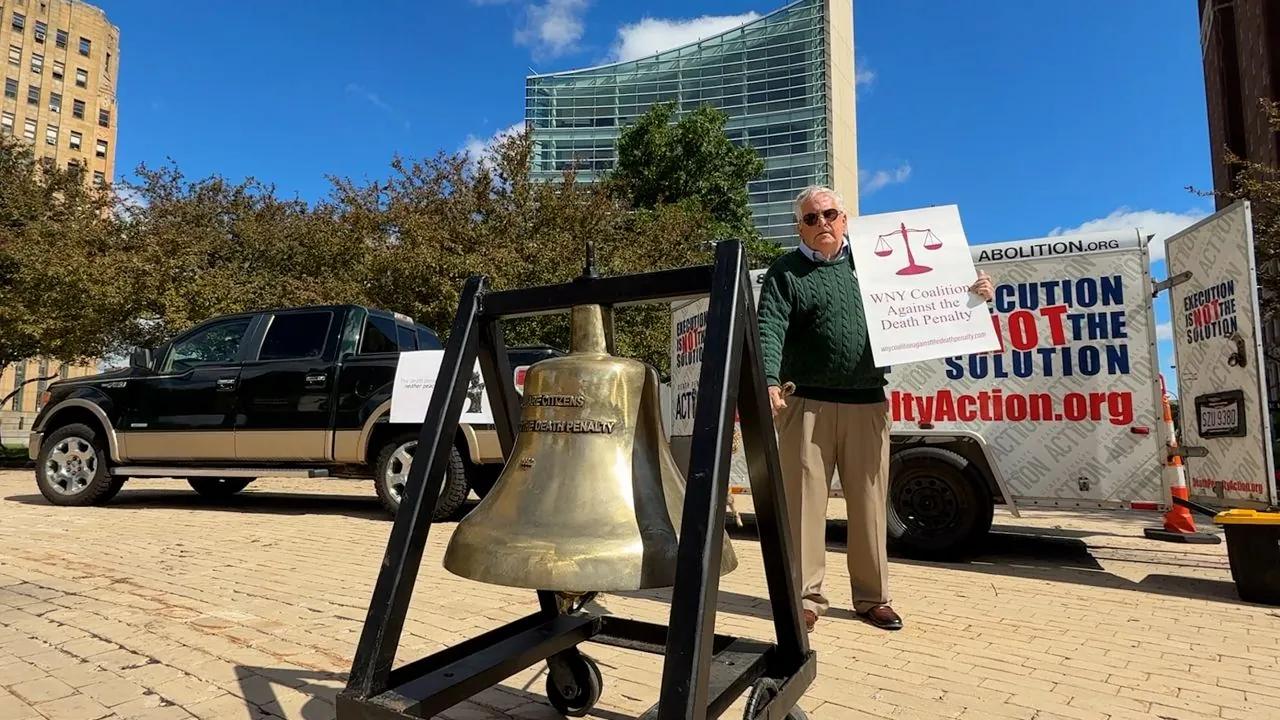
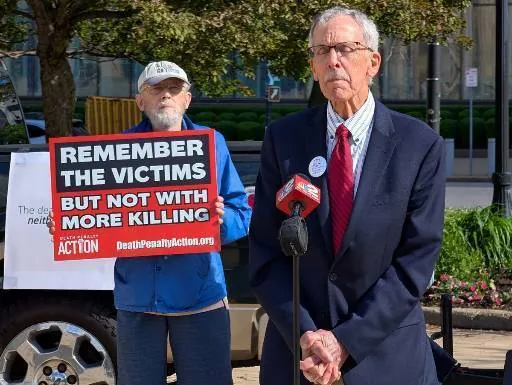
About Our Coalition

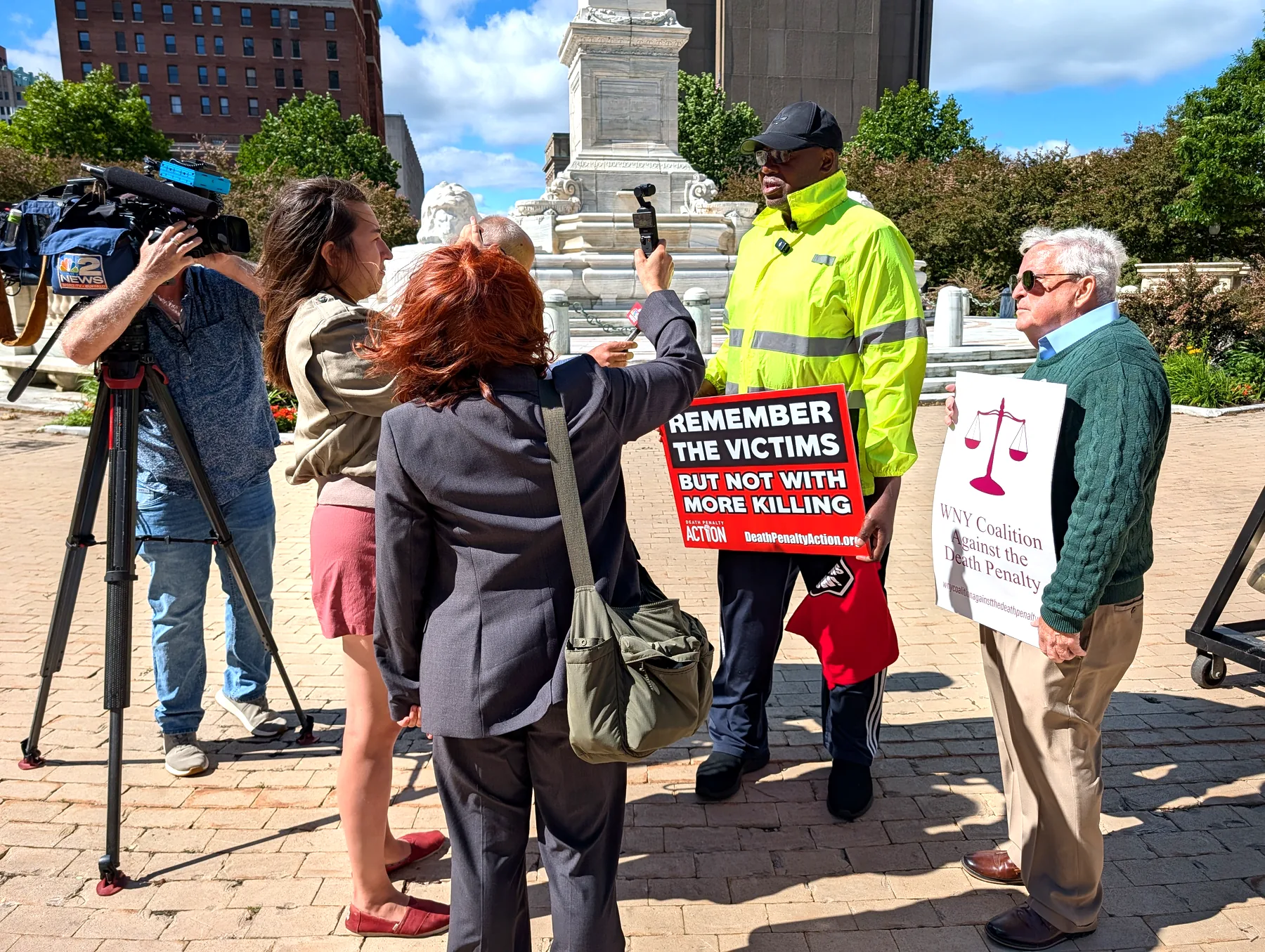
The WNY Coalition Against the Death Penalty is dedicated to abolishing capital punishment through advocacy, education, and community engagement. We aim to raise awareness about the moral and spiritual costs of punitive measures, emphasizing the importance of human rights and dignity for all individuals. Our coalition comprises diverse community members and organizations committed to social justice and the humane treatment of all.

WNY Coalition Against the Death Penalty is proud to announce that we are teaming with Death Penalty Action to promote our common cause to end capital punihment in states where it still exists and in federal courts.

To View their site please visit deathpenaltyaction.org
To Contribute to Death Penalty Action, please visit https://secure.actblue.com/donate/westernNY/

WNY Coalition Against the Death Penalty is proud to announce that we are teaming with Death Penalty Action to promote our common cause to end capital punishment in states where it still exists in federal courts.

To view their site please visit deathpenaltyaction.org

To contribute to Death Penalty Action, please visit https://secure.actblue.com/donate/westernNY/

Have additional questions?

We’re here to help. Let’s talk.

Join our newsletter to stay updated on our advocacy efforts and community events. Your voice matters in the fight against capital punishment!

We respect your privacy and promise not to send spam. Expect only valuable insights and updates from us.

← Back

Thank you for your response. ✨